

How To Clean Out An Alienware Alpha
The Alienware Alpha R2 gaming console has something to prove. When the first Alienware Alpha debuted in 2014, it failed to lure the faithful away from their Xbox Ones and PlayStation 4s. Still, its utility as a great petty affordable gaming computer was undeniable.
The Alpha R2 is an updated version that packs in a ton more performance. Unfortunately, this new gen isn't most as affordable equally the original was.
What's inside
Outside, Alienware'south tiny gaming PC looks exactly the same as its predecessor. Much has changed within, however, especially in storage options and graphics.
 Gordon Mah Ung
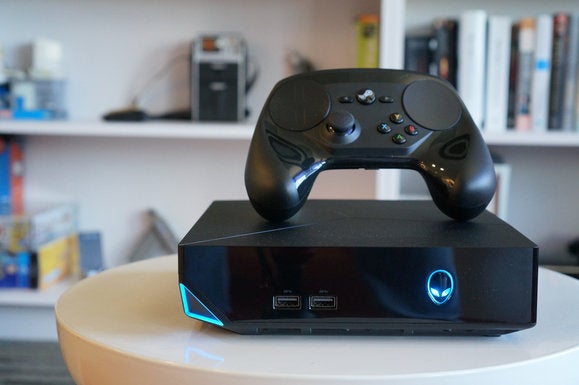
 Here'due south the Valve Steam Controller on elevation of the Windows-based Alienware Alpha R2 for scale. No, the R2 doesn't come up with the controller, kids.
The first major change is an expansion of the storage choices bachelor. One of the original Alpha's almost annoying problems was its difficult drive, which dragged forth like a gunkhole anchor. If you wanted an SSD, yous had to buy one separately, open up the system, and install it yourself. That's fine if you like DIY upgrades, but a lot of people don't.
The Alpha R2'due south base of operations version comes with a 2.5-inch HDD, but an M.2 PCIe SSD is optional.Alienware will also let you configure a system with both HDD and SSD.
The other important overhaul on the Alpha R2 is its graphics subsystem. The original Blastoff used an overclocked Nvidia GeForce GTX 860M flake, which was a keen feat in 2014.
Alienware has now one-upped itself by putting a total desktop Nvidia GeForce GTX 960 in the R2. Considering that typical GTX 960 video carte is almost the aforementioned book as the Alpha R2 itself (the PC is about 8 x eight ten 2 inches), that'due south an impressive bit of engineering.
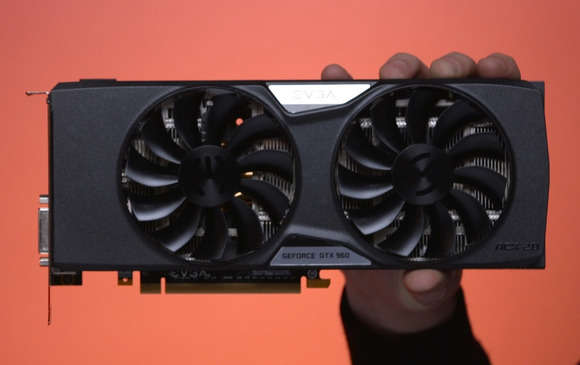
This is how big a typical Nvidia GeForce GTX 960 is.
You can guess what the tradeoff is, though. The GTX 960 throws off nigh twice the heat of the original Alpha'due south 860M, and then the Blastoff R2's fans are significantly louder.
In a typical living room with a Tv turned up to normal book, you'd accept barely heard the original Alpha's fans while playing a game. That's not going to drown out the tiny, high-rpm fans on the Alpha R2, but gamers who play with the volume cranked up may not mind.
The fan noise does at to the lowest degree pay off in cooling. The Blastoff R2's GTX 960 posted a cadre clock speed of 1,176MHz, a boost clock of i,201MHz, and a clock of 1,753MHz for its 4GB of GDDR5 RAM. Later on enduring an hr of torture in Furmark, a benchmark designed to put heavy stress on a GPU, the clocks showed no signs of thermal throttling. Alienware did its homework.
 Gordon Mah Ung
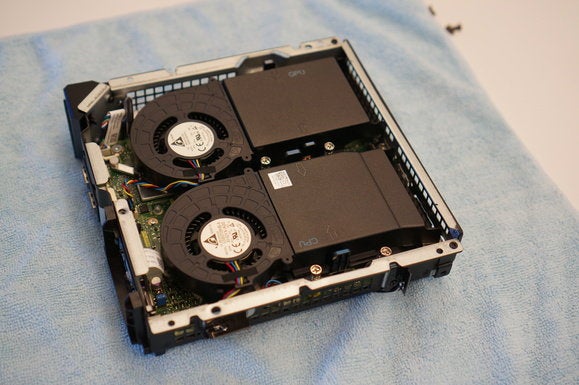
 Removing four Phillips-head screws from the Alienware Alpha R2 gives easy access to the unit's guts.
Performance
Besides going from a mobile GPU to a desktop model, Alienware has likewise given the Alpha a decent CPU upgrade. While the original Alpha offered 4th-generation Haswell dual- and quad-core options, the R2 has moved to 6th-generation Skylake CPUs. Yous can select between Core i3, i5, and i7 configurations.
Our particular unit of measurement came with the top-of-the-line Core i7-6700T. The 'T' in the proper noun indicates it's a lower-wattage CPU—35 watts. For comparison, a full desktop Cadre i7-6700 is 65 watts, while the overclockable Core i7-6700K is 91 watts.
To drop from 91 watts to 35, y'all give up a lot of clock speed. The base speed on a Core i7-6700K is iv.0GHz, while the Core i7-6700T'southward is 2.8GHz. Here are all three CPUs available for the Alpha R2, lined upward with a Core i7-6700K for context.
The expert news is the Cadre i7-6700T has a good for you Turbo Heave of 3.6GHz, so the functioning disparity isn't quite as big as yous'd think. In practical employ, the Blastoff R2 is pretty fast.
 Gordon Mah Ung
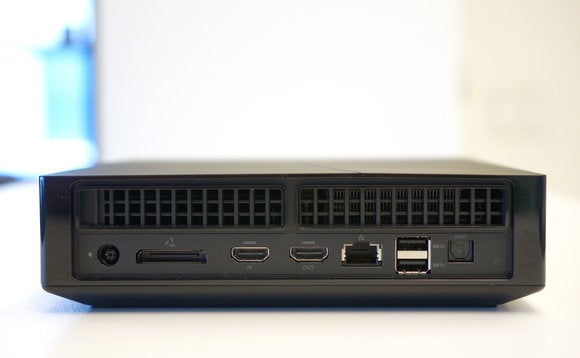
 The back of the Alpha R2 gives you an optical S/PDIF audio port, two USB 3.0 Type A ports, gigabit ethernet, HDMI ii.0 out, HDMI In, and a port that supports Alienware's Amplifier GPU enclosure.
CineBench R15 Performance
Here's the Alpha R2 compared to Intel's slap-up lilliputian Skull Canyon NUC with a quad-core Skylake processor, the original Alpha with a dual-core Core i3 chip, and our PCWorld nix-point desktop with a 4th-generation Haswell Core i7 CPU.
CineBench R15 is a quick benchmark that measures a PC's power to render 3D scenes. It's a great fashion to meet how a machine's processor stacks up, equally it favors those with more than CPU cores. The older Haswell chip wins here by a little scrap, thanks to its college wattage and college clock speed—even though it'due south the oldest CPU.
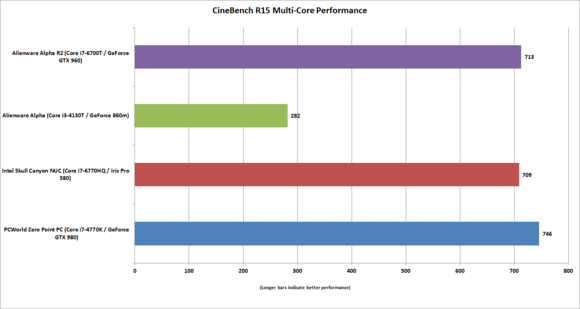
The Blastoff R2's quad-cadre Skylake CPU holds information technology own against a full desktop quad-cadre processor, also as Intel'due south fancy-pants Skull Coulee NUC.
HandBrake Performance
Our encoding test uses the costless and popular program Handbrake to convert a 30GB 1080p video file using the Android Tablet preset. Like CineBench R15, it's a pure CPU test and loves multiple cores. It also takes a long time to run, and then machines that can't handle the heat will show performance issues.
The Intel Skull Canyon NUC with its Core i7-6770HQ and 128MB of embedded DRAM leads the pack by a hair. The Alpha R2 with its Cadre i7-6700T comes in alee of our zero-indicate system's desktop Haswell chip, too—an impressive showing.
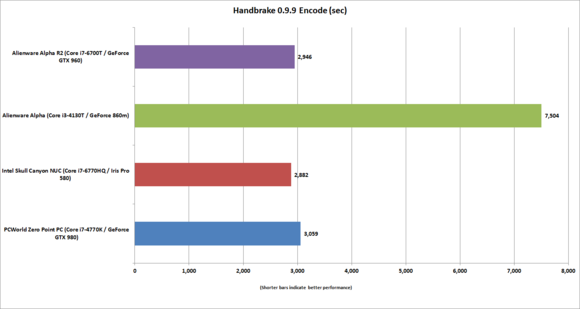
The quad-core Cadre i7-6700T holds its own against competing quad-cadre fries but fine.
The upshot for CPU functioning is that the Alienware Alpha R2 speeds along just fine. More important, nonetheless, is how information technology does in gaming.
3DMark Skydiver Performance
Up showtime is Futuremark's 3DMark examination. It'southward a constructed gaming test, simply generally respected for measuring gaming operation without favoritism.
Yous can come across in that location's a globe of performance difference between the Alpha R2's desktop GTX 960 and the original Blastoff'due south mobile GTX 860M. Intel's Iris Pro 580 in its Skull Canyon NUC is also pretty impressive for integrated graphics, merely it still takes a back seat to the GTX 860M.
Our PCWorld zero-point arrangement serves as a point of context: It runs a GeForce GTX 980 that's clearly much faster. In fact, the performance gap is much larger than this ane test would accept yous believe. 3DMark Sky Diver is a pretty light load designed to mimic mainstream 1080p gaming, so during the test, the zero-bespeak system'south GTX 980 is only idling almost of the time. Then while the Alpha R2'southward GTX 960 shows seventy percent of the GTX 980's performance in this benchmark, it would fall back to less than l percent of the GTX 980's output nether a tougher load.
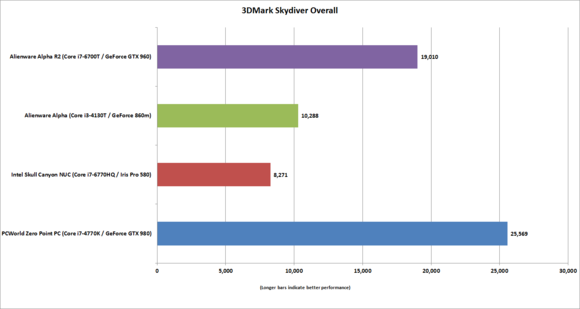
The GeForce GTX 960 in the Alienware Alpha R2 doubles the performance compared to the original Alpha.
Tomb Raider Performance
What well-nigh performance in a real game? To find out the answer, nosotros threw 2013's Tomb Raiderat the machines, with the resolution set to 1920×1080 and the graphics quality cranked to Ultimate. As you can see (and backing my exclamation from earlier), the Alpha R2's GTX 960 doesn't actually stand with a GTX 980 at all when you throw something a little harder at it. We're looking at half the functioning.
Merely that'due south non the point here. No one expects it to hang with what was once a top-tier $550 GPU. What's most important is that the tiny Alpha R2 can push Tomb Raider with an boilerplate frame charge per unit of 55 fps while set to 1080p and Ultimate. That'due south impressive.
That's also enough to tell me that in nigh games, yous tin probably expect 1080p performance with a few settings turned down. Not all games—don't look that level of performance in brand-new, graphically intense games like Rise of the Tomb Raider or The Division —but as I said, well-nigh games.
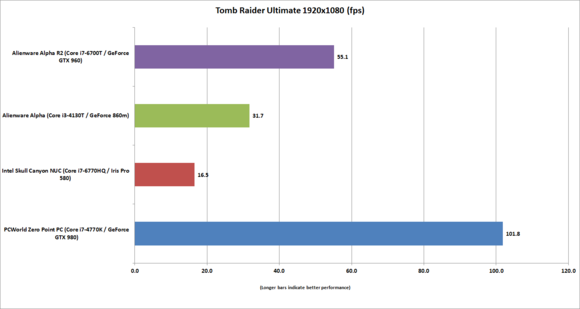
The new Blastoff R2 is capable of some gaming on Ultra or Ultimate, which the original could never handle.
You can use external graphics, likewise
The Alpha R2's chapeau fob for gaining more than operation comes via support for the Alienware Amplifier. You can plop any mod GPU into this cabinet, and then plug it into the Alpha R2's proprietary port to vitrify up its graphics output.
Yes, we know. Yous're already request, "Who in the hell buys a tiny little eight x eight-inch PC and then buys a giant external GPU cabinet?! Why not get a full-size tower PC?"
We'd hold with that, merely life is better with options. The Amplifier's appeal is that you at least have the option to upgrade functioning of the R2 in ii or three years if you make up one's mind you demand more functioning. If every mini PC and laptop had an Amplifier port three years ago, yous'd get a lot more utility out of them—if y'all wanted it.
What'south bully about the Amplifier is that information technology works, you lot tin get one right at present, and prices typically hover between $150 to $200. Compare that to the Razer Core, which isn't yet widely available and costs $500 for the cabinet lone. That's a steep markup, even if the Core doesn't use a proprietary connection similar the Amplifier does.
 Gordon Mah Ung
 Alienware's Amplifier cabinet lets you lot employ whatsoever modern GPU with the Blastoff R2 and many of its laptops. Unfortunately, information technology's huge.
Miniaturization is expensive
One sticking point for some people will exist the Alpha R2'southward cost: Our review unit's Core i7-6700T, GTX 960, 1TB seven,200 rpm bulldoze, and 8GB of DDR4/2133MHz RAM pushes $950. Yes, that'due south without the optional M.2 SSD.
When you step dorsum and think about information technology, that price isn't out of line for a mini-PC.The Zotac EN970, a very similar bare-basic organisation, will set you lot dorsum $730 if you buy it throughAmazon. Once you add together storage, RAM, and an Os, you lot're looking at cost parity with the Alpha R2—but with the disadvantage of an older, slower Core i5 Broadwell CPU.
Still, you're probably thinking that for that much money, you could simply buy a far more capable tower PC. That's true, but the operative words there are "belfry PC." That's going to be far larger. Ultimately, yous'll always pay a premium for miniaturization, whether you spend that cash on an Alienware Alpha R2, Zotac EN970, or Intel Skull Coulee NUC. If a tiny PC isn't your matter, but drive on.
 Gordon Mah Ung
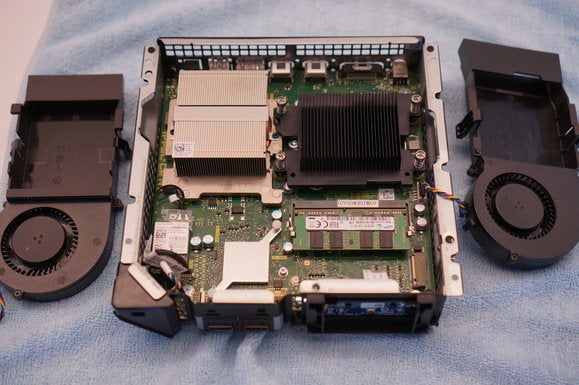
 An interior shot of the Alpha. On the right (and under a oestrus sink) is a low-wattage quad-core Skylake Cadre i7 in a standard LGA1151 socket. On the left is the GeForce GTX 960, which is permanently fastened to the motherboard. You also go a solitary 8GB DDR4 So-DIMM of RAM in single-channel style, and simply in front of it is an M.ii slot.
Determination
The Alpha R2'southward two principal negatives are excessive fan noise and inclusion of a difficult-deejay drive as standard. HDDs as primary drives just stink. Sure, you can fix the hard bulldoze event, merely you'll pay for it. The aforementioned may go for the fan racket: You may need to invest in headphones to ignore information technology, if y'all live with (or side by side to) people who tin can't stand hearing a loud TV.
These ii drawbacks don't take away from what Alienware has done with the Blastoff, though. You're really getting a ton of performance from a machine with the aforementioned book every bit a two-liter canteen. Information technology'due south capable of playing virtually games on High to Ultra settings at 1080p, which is an amazing accomplishment for something and then modest.

How To Clean Out An Alienware Alpha,
Source: https://www.pcworld.com/article/415662/alienware-alpha-r2-review-a-tiny-pc-gets-meaner-faster-and-louder.html
Posted by: wilsonglond1958.blogspot.com
0 Response to "How To Clean Out An Alienware Alpha"
Post a Comment